
AI-generated illustration
Looking Outwards
Ravin de la Creuse was painted in 1889 in the Creuse Valley. The work combines the dramatic topography of the Creuse with Monet’s characteristic exploration of colour, light and atmosphere. Within the ten-painting sequence featured in our presentation, it occupies the final position, bringing the series to a fitting close.
Ravin de la Creuse
The painting depicts a deeply incised landscape, with rock formations drawing the eye towards the water. Dark shades of violet-blue and green meet warm tones of ochre, pink and gold in the water and sky.
Monet does not depict the landscape in every detail. Instead, he distils it into an interplay of areas of colour and brushstrokes. The character of the place emerges from their combined effect.
The accompanying artwork documentation particularly highlights Monet’s horizontal brushstrokes, vibrant use of colour and emphasis on light and atmosphere.
Explore the Details Move your cursor over the painting to magnify individual details.
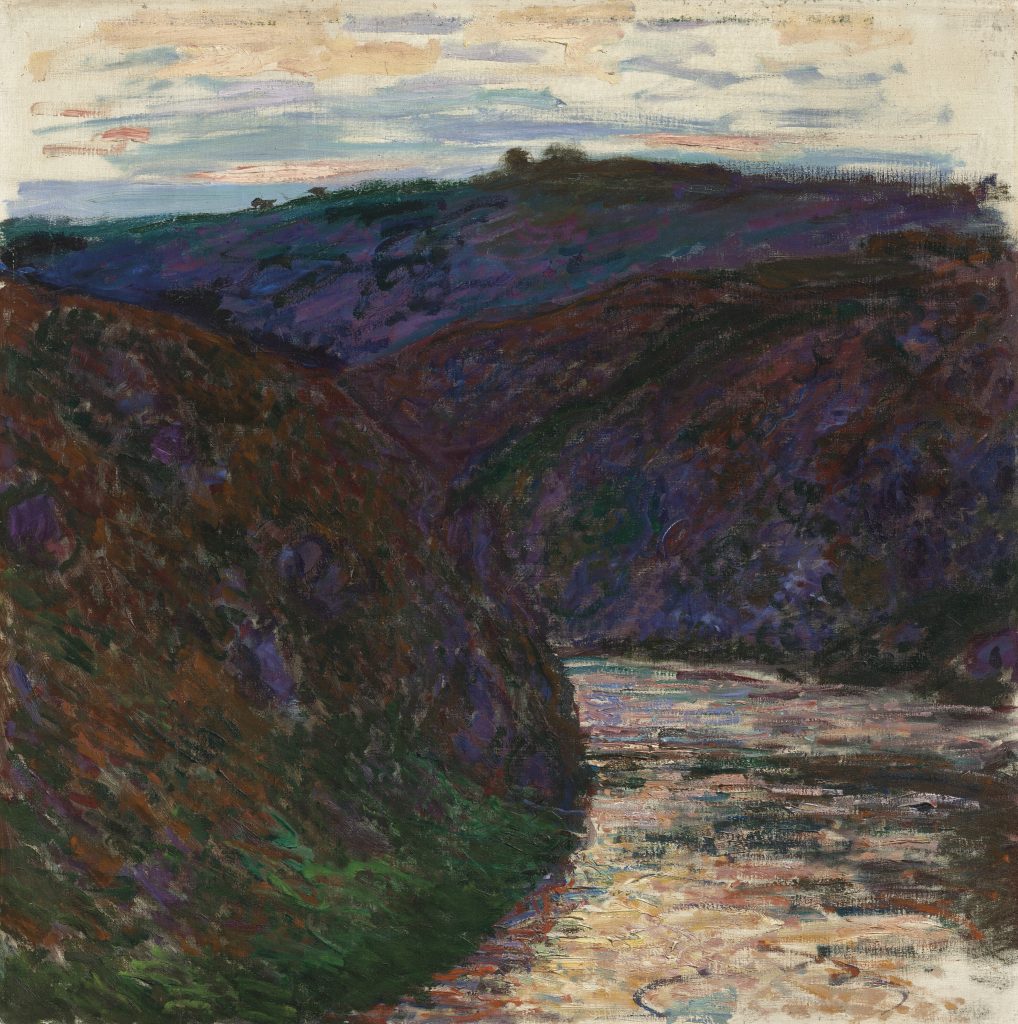
The Artwork at a Glance
Claude Monet
1840–1926
Ravin de la Creuse
Year of Creation
1889
Medium
Oil on canvas
Dimensions
73.2 × 73.2 cm
The artwork documentation lists the painting as Ravin de la Creuse, bearing the signature “Claude Monet” on the reverse, and dates it to 1889.
Cataloguing
Wildenstein Catalogue Raisonné
Band III, Köln 1996
Nr. 1227
Take a Closer Look.
A Monet painting is not meant to be appreciated from a distance alone. The closer you look at the canvas, the more clearly you can see how individual brushstrokes come together to create a landscape.
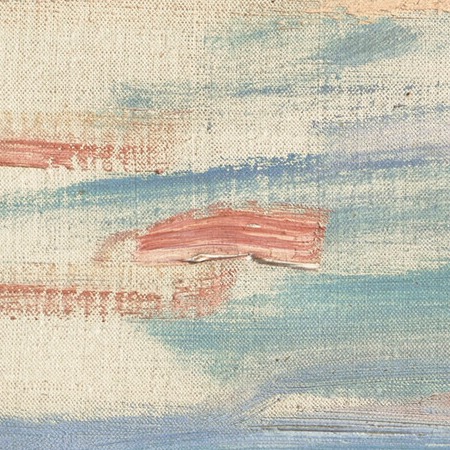
Heaven
Delicate shades of blue, pink and ochre sweep across the sky in loose, horizontal brushstrokes. The colours blend into one another, bringing the light above the landscape to life.
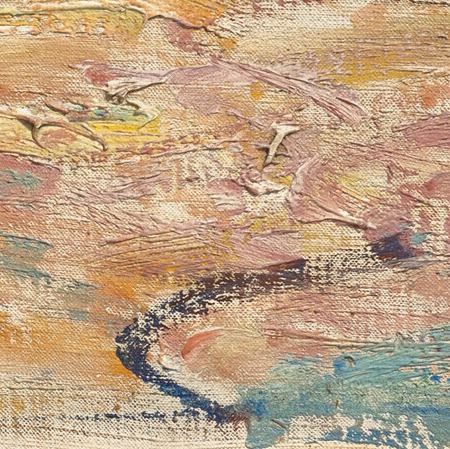
Water
The water glows with shades of ochre, pink, pale blue and cream. The colourful brushstrokes evoke reflections of the sky, clearly distinguishing the water’s surface from the dark rocks.
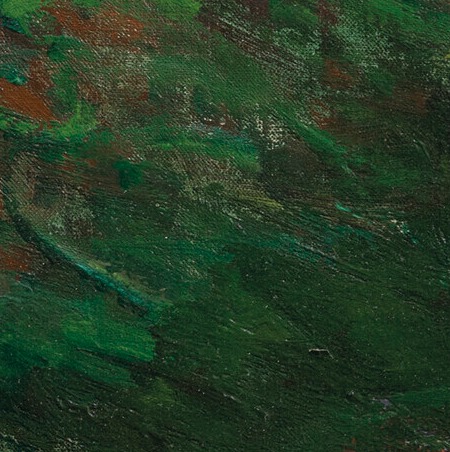
Vegetation
Dark shades of green, brown and rust mingle with touches of violet across the steep slopes. The short, interlocking brushstrokes blend the vegetation into the rocky terrain.
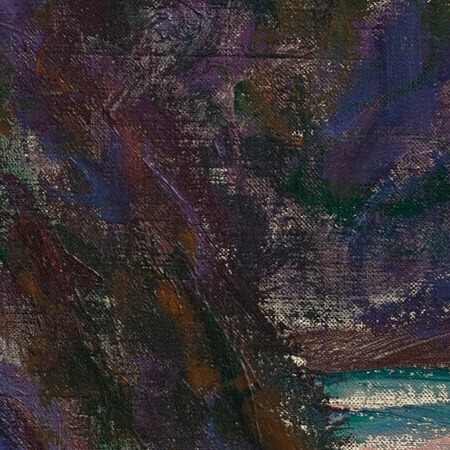
Rocks & Gorge
Dark shades of brown and violet define the steep rock faces as they descend deep into the valley. The interplay of light and shadow accentuates the depth of the gorge, creating a striking contrast with the bright water.
When Landscape Becomes a Study of Light
For Monet, the landscape of the Creuse was more than just a new subject. During his stay, he repeatedly returned to the same views of the landscape. The topography remained largely unchanged, yet light, weather, time of day and atmosphere transformed its appearance.
This shifts the focus of his work:
The landscape itself is no longer the sole subject. Its transformation becomes the true subject.
The Creuse painting campaign is regarded as an important step in the development of Monet’s approach to painting in series. The Art Institute of Chicago describes the paintings created in 1889 as a deliberately conceived group of works, highlighting that this was the first time Monet consistently adopted the practice of presenting the paintings together as a deliberate artistic strategy.
Ravin de la Creuse Within the Series
Ravin de la Creuse is not considered in isolation. Only when viewed alongside the other works in the series does it become clear what Monet was exploring: the same landscape in different states. The ten-painting sequence featured in our presentation traces this development, culminating in Ravin de la Creuse.
A Painting with a History
The Exhibition
Munch-Museum, Oslo, Norwegen
February 2027 – August 2027
138 years after it was painted, Ravin de la Creuse (W 1227) returns to the international stage.
From 19 February to 23 May 2027 it will be on display at the MUNCH Museum in Oslo. The exhibition places Monet’s works from the Creuse Valley and his exploration of light, landscape and atmosphere within an international context.
The Exhibition “Monet – Wild and Tamed” brings together some of Claude Monet’s most celebrated works and offers a rare insight into the landscape painting of an artist who played a pivotal role in the development of modern art.
With more than 50 works, the exhibition spans the final four decades of Monet’s career. It explores his artistic engagement with a wide variety of landscapes – from the rugged Mediterranean coast and Brittany to the Creuse Valley and the winter landscapes of Norway. These wild natural surroundings are contrasted with the carefully cultivated garden at Giverny, which became Monet’s most important subject from the mid-1890s onwards. The exhibition also focuses on his celebrated Water Lilies paintings and his late works, in which he continued to explore the possibilities of painting with remarkable freedom and expressive power.
Past Exhibitions
Treviso · Case dei Carraresi
Monet, I luoghi della pittura
September 2001 – February 2002
Nr. 51
The painting was exhibited there and reproduced in the exhibition catalogue.
Ravin de la Creuse was painted in the spring when Claude Monet repeatedly returned to the landscape of the Creuse, seeing it anew each time.
Amid rocks and water, he was not seeking an unchanging image of nature.
He was searching for the moment when light transforms a familiar subject into something new.
Ravin de la Creuse captures one of these moments.
SERVICE
LEGAL INFORMATION
Copyright 2026 by red shark advertising GmbH

